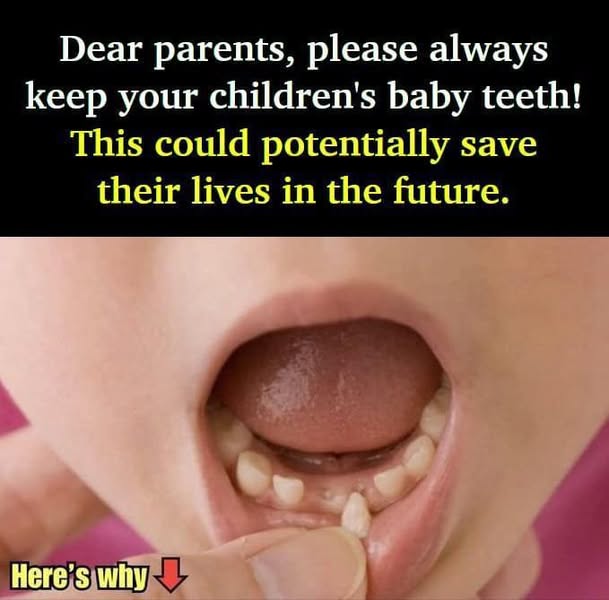
Doctors are urging parents to save their baby’s teeth, which could be a lifesaving treasure if the child develops a potentially fatal disease as they grow.
In 2016, 7-year-old Jenson Wright was diagnosed with leukemia ravaging 65% of his tiny body.
This was his 2nd cancer diagnosis – when Jenson was only four, he had lymphoma and leukaemia – and since two rounds of chemotherapy failed, his parents were losing hope that their boy would survive.
According to an old Facebook post shared by his mother Carolyn, the cancer was destroying his “body like a wildfire, so rapid, we feared the outcome would be every parent’s nightmare.”
But then a miracle happened.
“A mother in Texas gave the gift of a future to Jenson the day her child was born by donating her umbilical cord. A selfless act by one parent to another,” Carolyn writes of the stem cell-rich umbilical cord that was stored by the other mom for future medical purposes.
Umbilical cord blood
Stem cells are described by the Mayo Clinic as special cells that “self-renew.” These healthy cells can also become “other cells that do different things in a process known as differentiation.” To further clarify, stem cells can become “brain cells, heart muscle cells, bone cells or other cell types.”
Only five days after the groundbreaking surgery, the healthy new cells from the cord blood started killing the disease inside Jenson.
“What was no longer needed by one child, gave life to another,” Carolyn writes of the stem cell transplant.
In 2019, Carolyn shared another post on social media, explaining the doctors said that “Jenson is cured of cancer,” and officially “off the clinic list with no further follow ups required.”
Jenson is now a healthy 16-year-old high schooler.
Biological insurance policy
Now, researchers are looking at how a simple baby tooth could one day save a life.
That’s the pitch behind dental pulp stem cell banking – an option that promises parents a biological insurance policy against future illnesses.
According to a report published in the National Library of Medicine, “stem cells from human exfoliated deciduous teeth (SHEDs) are the best candidates for personal cell banking,” and “they can be obtained less invasively in the natural process.”
Most importantly, because they are the donor’s own cells, there is no risk of rejection if needed to treat disease or repair injury.
Instead of discarding a child’s lost tooth, parents can send it to a stem cell bank where it is preserved for potential future medical use.
Growing new cells
Stem cells are the body’s raw materials – cells that can develop into many different cell types.
Baby teeth contain a specific type of stem cell found in the dental pulp, called mesenchymal stem cells (MSCs). These cells have the potential to regenerate damaged tissues, grow new cells, and even repair organs.
Unlike embryonic stem cells, which are controversial due to their origin, or bone marrow stem cells, which require invasive procedures, dental stem cells are collected non-invasively. The process involves storing the tooth under controlled conditions, so the stem cells remain viable for future use.
Worth the investment?
It sounds like a groundbreaking opportunity, but there’s a catch: the science isn’t quite there yet. While research into dental pulp stem cells (DPSCs) is promising, real-world therapies remain on the horizon.
Given the uncertainty, is it worth the investment? Private stem cell banks charge fees for collection and long-term storage, which can add up over the years. Some families may find peace of mind in knowing that they have taken a precautionary step toward their child’s future health, even if the odds of ever needing the stem cells are low.
On the other hand, public stem cell banks – like cord blood – provides more immediate medical benefits and are already being used for treatments. Parents might find it more practical to invest in established medical options rather than experimental possibilities.
What are your thoughts on the revolutionary findings? Would you be willing to pay to have this kind of health insurance for your child, or even yourself? Please let us know your thoughts and then share this story so we can hear from them!