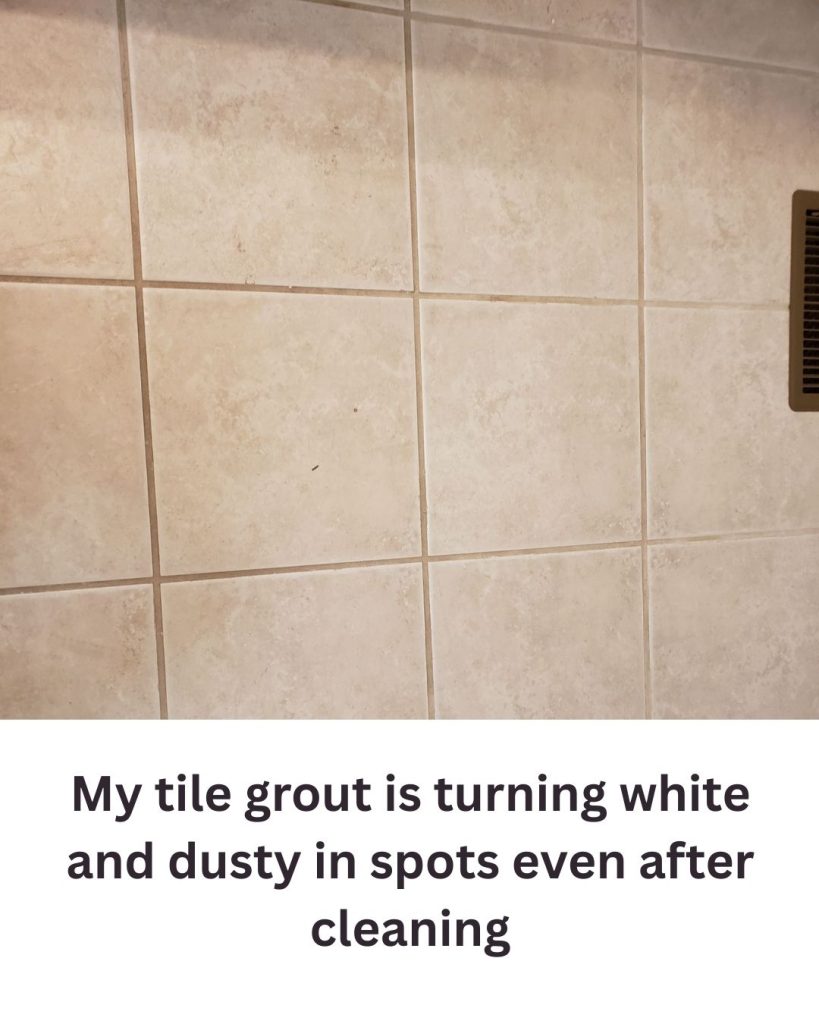

If your once-dark grout has turned chalky white, you’re not alone. This is a common issue in showers — especially pebble floors — and it can be frustrating when scrubbing and household cleaners don’t fix it.
The whitening usually points to one of a few underlying causes. Identifying the correct one is key to fixing it properly.
1️⃣ Efflorescence (Most Common Cause)
Efflorescence is a white, powdery mineral deposit that forms when moisture travels through cement-based grout and brings dissolved salts to the surface. When the water evaporates, it leaves behind a white residue.
Why it happens:
- Excess moisture under the tile
- Poor drainage in the shower pan
- Blocked weep holes in the drain
- Improper slope toward the drain
- Highly porous grout
Important: Efflorescence is a symptom of a moisture issue, not just a surface stain.
How to test:
- Let the shower dry out completely for several days.
- Try a small test area with diluted white vinegar.
- If it lightens or dissolves, it may be efflorescence.
⚠️ Vinegar should only be used as a test. Frequent acid use can damage grout.
Proper solution:
- Use a professional efflorescence remover made for tile and stone.
- Improve drainage and ventilation.
- Check for clogged drain weep holes.
- Ensure the shower pan is properly sloped.
If moisture is continuously trapped underneath, the white residue will likely return.
2️⃣ Latex or Polymer Leaching
If vinegar does nothing, the issue may be latex leaching. Some modified grouts contain polymers that can rise to the surface and leave a white or hazy film.
Solution:
Use a grout haze or latex residue remover specifically designed for this condition.
3️⃣ Trapped Moisture + Non-Breathable Sealer
If a surface sealer was applied that doesn’t allow vapor to escape, moisture can get trapped underneath. This causes cloudiness or whitening in the grout.
Fix:
- If it’s a surface (topical) sealer, it may be possible to strip it.
- If it’s a penetrating sealer mixed into the grout, removal can be more difficult.
- In severe cases, grout replacement may be necessary.
What About Resealing?
Before resealing:
- Make sure the grout is completely dry.
- Confirm that drainage issues are resolved.
- Use a breathable penetrating sealer, not a heavy surface coating.
Applying new sealer over a moisture problem will only trap it again.
Alternative Option: Grout Colorant
If the structural installation is sound but staining persists, grout colorants can:
- Restore uniform color
- Seal the grout surface
- Provide a long-term cosmetic solution
However, this treats the appearance — not the root cause.
Final Thoughts
When grout turns white, the issue is usually moisture-related. Cleaning the surface may temporarily improve appearance, but long-term correction requires identifying why water is not drying properly.
If the problem continues to worsen, consulting a tile professional to inspect the shower pan and drainage system may be the safest next step.