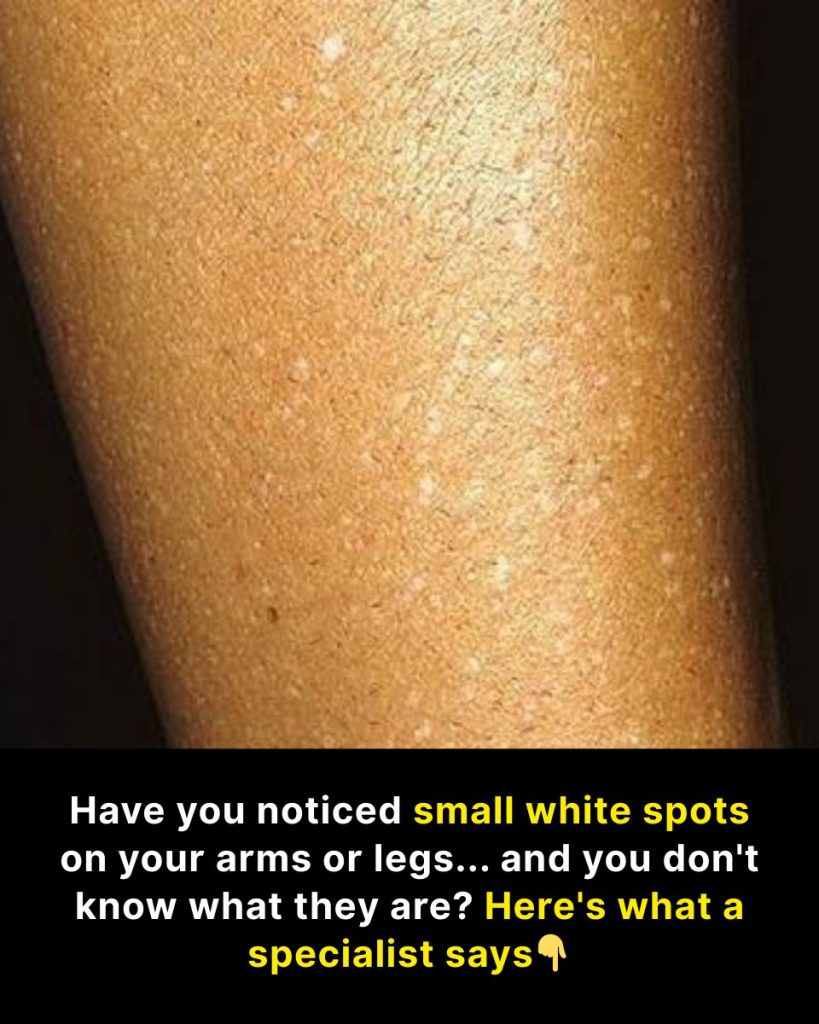

As summer fades and skin tones begin to lighten, many people start noticing tiny pale dots appearing on their arms and legs.
These small white spots often become more noticeable as a tan disappears, standing out against slightly darker surrounding skin. For some, they seem to multiply over time, which can naturally raise questions or concern.
If you’ve spotted these marks and wondered what they are or whether they signal a health problem, the explanation is often reassuring.
What Are These Small White Spots?
These marks are commonly known as idiopathic guttate hypomelanosis, or IGH. While the name may sound alarming, the condition itself is harmless and extremely common.
IGH refers to small, flat white patches that form when the skin loses melanin, the pigment responsible for giving skin its color. The spots are usually only a few millimeters wide and can appear in people of all skin tones and backgrounds.
They most often show up on areas that receive frequent sun exposure, such as the legs, arms, and sometimes the face. Studies suggest that around 50% to 80% of people over the age of 40 will develop at least a few of these spots, making them a normal part of the skin’s aging process.
Why Do These Spots Appear?
Long-term sun exposure is considered the main cause of IGH. Over many years, ultraviolet (UV) rays gradually damage melanocytes, the cells that produce melanin. When these cells become less active or disappear entirely in small areas of skin, those areas lose pigment and appear lighter.
In simple terms:
UV exposure damages pigment-producing cells
Melanin production decreases in specific spots
Those areas appear pale or white
Importantly, these spots are not dangerous and are not linked to serious medical conditions.
Can IGH White Spots Be Treated?
At present, there is no proven medical treatment that can permanently remove IGH.
You may see various options mentioned online, including:
- Topical retinoids
- Chemical peels
- Laser or light-based treatments
Dermatology experts note that once melanocyte cells are lost, it is difficult to restore pigment. As a result, these treatments tend to offer inconsistent or temporary results, which is why they are generally not strongly recommended for IGH alone.
Could These Spots Be Something Else?
White patches are sometimes mistaken for fungal infections such as tinea versicolor, leading some people to try antifungal creams or shampoos. In most cases, these treatments won’t help, because IGH is not caused by fungus.
There are a few key differences:
IGH spots usually appear on the arms and legs and are flat and smooth
Fungal patches often show up on the chest, back, or shoulders and may feel itchy or look slightly scaly
If your spots are spreading rapidly, changing appearance, or causing discomfort, it’s best to consult a healthcare professional to rule out other skin conditions.
What Can You Do If They Bother You?
While IGH cannot be fully cured, there are ways to manage their appearance:
- Use body makeup or self-tanner to help even out skin tone
- Apply sunscreen regularly to reduce the risk of new spots forming
- Keep skin well moisturized to improve its overall look
Above all, it’s important to remember that these white spots are normal, harmless, and very common with age. They are not a sign of unhealthy skin, but simply a visible reminder of time and sun exposure.