
Almost every fridge has it.
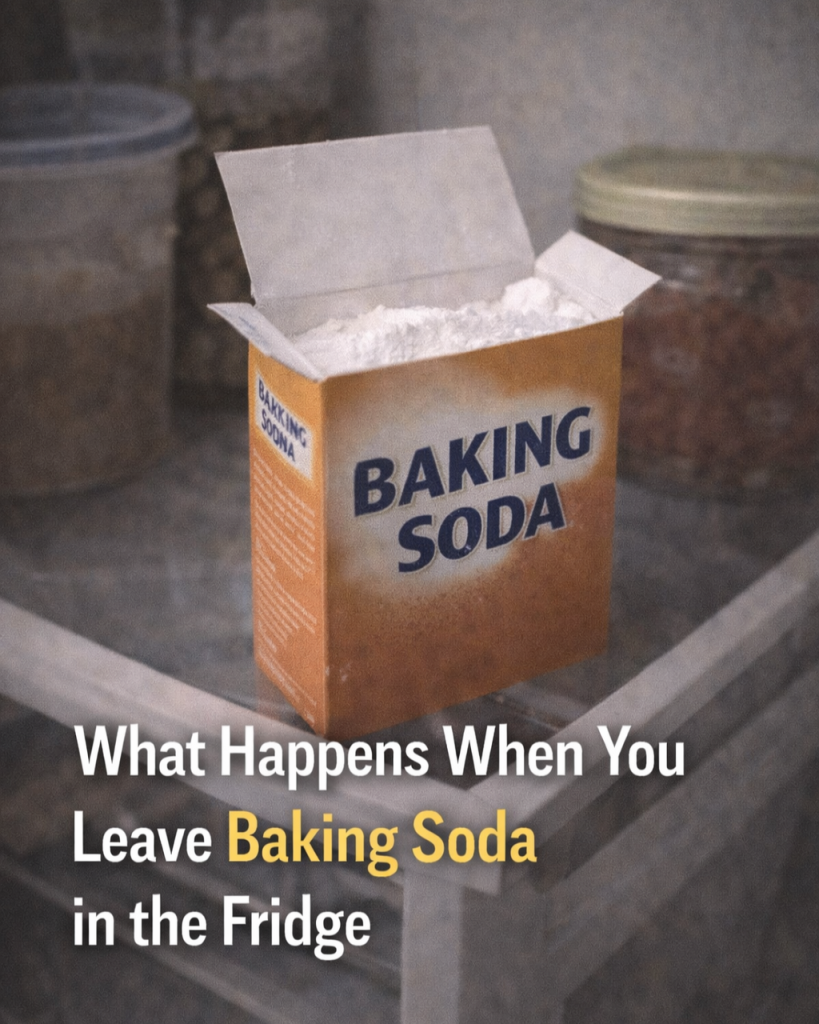
A small open box tucked in the corner. Forgotten. Rarely replaced.
Most people know baking soda is “for smells,” but few understand what actually happens when you leave it in the fridge — or why it sometimes works perfectly… and other times does nothing at all.
The truth is more interesting than the myth.
Baking Soda Doesn’t Mask Odors — It Traps Them
Baking soda (sodium bicarbonate) doesn’t cover bad smells the way air fresheners do.
It neutralizes them.
Odors in your fridge come from acidic or basic molecules released by food — leftovers, spoiled produce, dairy, or meat. Baking soda reacts chemically with these odor molecules, changing their structure so they no longer smell.
That’s why it works silently, without fragrance.
No scent.
No cover-up.
Just absorption and neutralization.
Why the Fridge Is the Perfect Place for It
Refrigerators are enclosed spaces with constant airflow.
Every time the fan circulates cold air, odor particles move through the fridge — and past the baking soda. Over time, the baking soda captures and neutralizes more and more of them.
This is why placement matters.
An open box on a shelf works better than one hidden in a drawer. The more airflow it gets, the more effective it becomes.
What You’ll Notice Over Time
If baking soda is working properly, you may notice:
-
Fewer lingering food smells
-
Less odor transfer between foods
-
A “neutral” fridge smell instead of a sour one
-
Improved freshness perception
What you won’t notice is instant results.
This isn’t a spray. It works gradually.
Why It Sometimes Stops Working
Here’s the part most people don’t realize.
Baking soda doesn’t work forever.
Once it’s absorbed as many odor molecules as it can, it becomes inactive. At that point, it looks the same — but it’s done its job.
That’s why old baking soda in the fridge often does nothing.
Experts recommend replacing it every 30 days. Some suggest writing the date on the box to avoid forgetting.
If it’s been sitting there for months, it’s not helping anymore.
The Mistake Almost Everyone Makes
The biggest mistake?
Leaving baking soda sealed or barely open.
If air can’t reach it, odor molecules can’t either.
For best results:
-
Open the box fully
-
Or pour baking soda into a shallow bowl
-
Place it where air circulates
More surface area = better odor control.
What Baking Soda Can’t Fix
Let’s be clear.
Baking soda won’t solve:
-
Spoiled food
-
Leaking containers
-
Mold growth
-
Strong, active rot odors
If something smells bad, you still need to find and remove the source.
Think of baking soda as maintenance, not emergency cleanup.
Bonus Uses Inside the Fridge
People who regularly use baking soda often go further.
They use it to:
-
Deodorize produce drawers
-
Absorb odors in crisper compartments
-
Neutralize smells in reusable containers
-
Clean fridge shelves gently
A paste of baking soda and water removes stains without scratching plastic or glass.
The Science Behind the Simplicity
The reason this trick has survived for generations is simple:
It works — quietly and cheaply.
Baking soda is stable, non-toxic, and effective at odor neutralization. That’s why it’s used in everything from refrigerators to carpets to shoes.
No gimmicks. Just chemistry.
Why This Habit Is Still Worth Keeping
In a world full of scented sprays and disposable gadgets, baking soda remains one of the most effective odor solutions — and one of the least talked about.
It doesn’t announce itself.
It doesn’t smell “clean.”
It just removes the problem.
The next time you open your fridge and notice it smells neutral instead of fresh or foul, chances are the baking soda did its job.
Just remember to replace it.
Because once it’s full, it’s finished — even if it looks brand new.