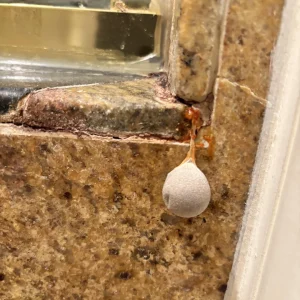
Finding a tiny pale “worm” crawling on fabric can be alarming, especially when it appears out of nowhere. Based on its size, color, and segmented body, this is most likely a moth larva, often referred to as a clothes moth larva rather than a true worm.
These larvae are small, cream-colored, and soft-bodied, and they often show up on blankets, clothing, rugs, or upholstered furniture. Unlike actual worms, they are the immature stage of a moth. In many homes, they are discovered only after they leave a hidden feeding area and start wandering across fabric or walls looking for a place to pupate.
If this is a clothes moth larva, it likely got there because an adult moth laid eggs somewhere nearby. The eggs are tiny and easy to miss. Once they hatch, the larvae feed on materials that contain natural fibers such as wool, cashmere, fur, feathers, or fabric covered in hair, lint, skin flakes, or food residue. That is why they are sometimes found on throws, blankets, closets, stored clothing, or dark, undisturbed corners.
Another possibility is that it could be a small pantry moth larva that wandered away from a food source. Pantry moth larvae can travel surprisingly far from infested dry goods like cereal, rice, flour, pet food, birdseed, or snacks before settling down to pupate. But because this one is on fabric and looks smooth and pale, many people would first suspect a fabric-related moth larva.
The good news is that a single larva does not always mean a major infestation, but it does mean you should inspect the area. Check nearby blankets, closets, rugs, pet bedding, and stored fabrics for more larvae, webbing, shed skins, or small damaged spots. Wash or dry-clean vulnerable fabrics, vacuum thoroughly, and pay special attention to baseboards, closet corners, and under furniture. If you have dry food stored nearby, inspect that too just in case it came from a pantry source instead.
So what is it? Most likely, it is a tiny moth larva, probably a clothes moth larva, and it got there because eggs were laid in or near fabric or another hidden food source inside the home. It may look like a worm, but it is really a sign that something nearby may be attracting fabric- or food-feeding moths.