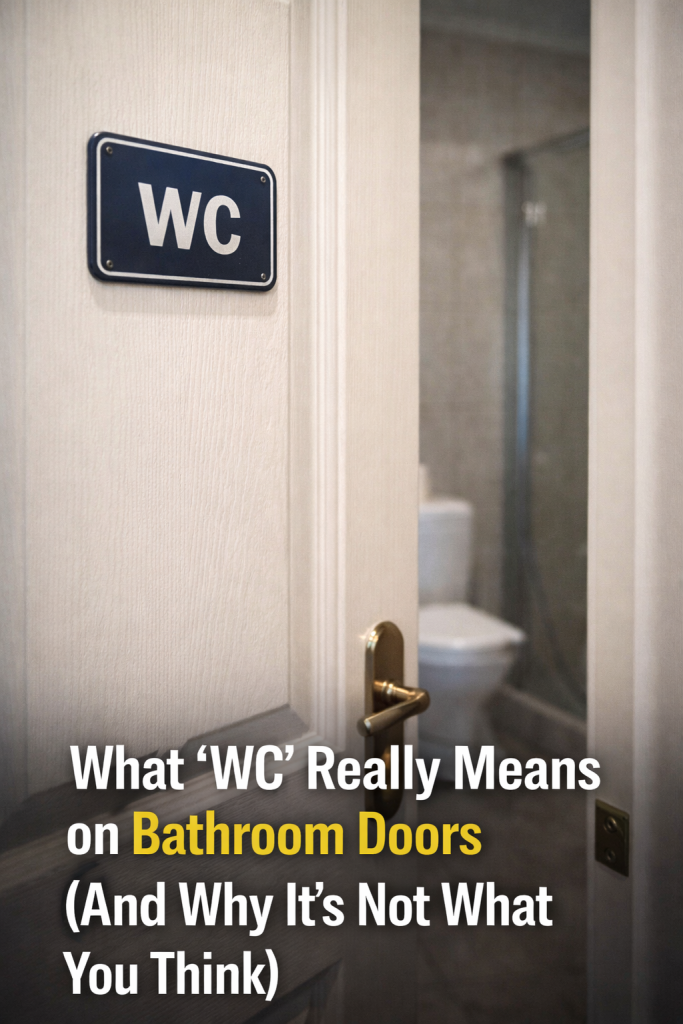

You’ve seen the letters countless times.
On airport signs. Restaurant hallways. Hotel corridors. Old buildings across Europe.
WC.
Most people walk past it without thinking. You know it means bathroom… but what does it actually stand for? And why do some places still use it instead of “Restroom” or “Toilet”?
The answer is a small piece of history hiding in plain sight.
It Doesn’t Mean What Most People Guess
A lot of people assume WC stands for something modern — like “Wash Closet” or “Water Chamber.”
Close… but not quite.
WC stands for “Water Closet.”
The term dates back to the 1800s, when indoor plumbing was a brand-new luxury. Before that, bathrooms were separate outdoor structures or shared public facilities. Having a private indoor toilet connected to running water was revolutionary.
The phrase “water closet” described a tiny enclosed room that contained a flushing toilet. It was literally a closet with water.
And at the time, that was cutting-edge technology.
A Symbol of Wealth and Modern Living
In Victorian-era homes, the water closet was considered a status symbol.
Only wealthy households could afford indoor plumbing. Guests were often impressed by the idea of a private, hygienic space inside the house. The term sounded elegant and technical — much more refined than simply saying “toilet.”
Over time, architects and builders began labeling these spaces as WC on floor plans and public signage.
The abbreviation stuck.
Why Europe Still Uses It
While North America gradually switched to words like bathroom and restroom, many European countries kept WC as the universal symbol.
It became a neutral, language-free label understood by travelers from different cultures. No translation needed. Whether you spoke English, French, German, or Italian — WC meant the same thing.
Even today, you’ll see WC signs in airports, trains, and restaurants across Europe and Asia. It’s one of the few symbols that survived centuries of language change.
The Psychology of Bathroom Words
Interestingly, societies often invent softer words for bathrooms.
We say:
-
Restroom
-
Washroom
-
Powder room
-
Facilities
-
Comfort station
Why? Because humans historically avoided direct references to bodily functions in polite conversation. WC sounded technical and discreet — almost clinical.
It allowed people to talk about the space without embarrassment.
Language evolves, but social habits stick.
Why Hotels and Public Spaces Keep It
Modern designers still use WC on signs for a simple reason: clarity.
It’s short. Recognizable. International.
When you’re in a foreign country and urgently searching for a bathroom, you don’t want to decode vocabulary. You want a symbol you instantly understand.
WC became one of the earliest global icons of travel infrastructure.
In a way, it’s one of the original universal signs — older than Wi-Fi symbols or exit arrows.
A Tiny Word With Big History
The next time you see WC on a door, you’re looking at a piece of 19th-century innovation that never disappeared.
It’s a reminder of when indoor plumbing transformed daily life. What feels ordinary today was once futuristic.
And like many everyday objects, the words we stop noticing often carry the most interesting stories.
Two letters. Over a century of history.
All hiding on a bathroom door.